K-1 Visa Lawyer
Engaged to a Partner Abroad and Planning the Wedding Here
If the wedding will be in the United States, the K-1 brings your partner here for it, and attorney Zachary Gold checks at a free consultation whether you can file today.
- 5.0 108 Google reviews, Ewing office
 AILA memberAmerican Immigration Lawyers Association
- Since 1995Family firm founded by Marta Cruz Gold
- ¡Hablamos español!We work in English and Spanish
How can we help?
Pick a time below for a free 20-minute consultation with attorney Zachary Gold.
A visa for the wedding, a green card after it
With a K-1 visa your fiancé or fiancée comes to the United States, marries you within 90 days and then applies for a green card without leaving. As your K-1 visa lawyer, attorney Zachary Gold of Cruz Gold & Associates checks whether you can file now, prepares the petition and your partner for the consular interview, and handles the green card application after the wedding.
The K-1 suits couples who want the wedding here. Couples who are already married, or who plan to marry abroad, file a spouse petition (USCIS), the route on our marriage green card page. Immigration law is federal, so we take K-1 cases for citizens in any state, and the firm has offices in Ewing, Hackensack, Philadelphia and Houston.
Who can file for a K-1 visa?
Only a U.S. citizen can file, and only for a partner the citizen is free to marry and has met in person within the last two years.
- A green card holder cannot file a fiancé(e) petition (I-129F instructions).
- Both of you must be free to marry on the day you file, with every earlier marriage already ended by divorce, death or annulment. A petition filed a few weeks before a divorce became final cannot support a visa even after the decree arrives: the consulate sends it back to USCIS and you file again (State Department; 9 FAM 502.7).
- The meeting in person must fall within the two years before the filing date. The I-129F instructions name a statement of how you met, airline tickets and passport pages as proof, and a denial for this reason does not stop you from filing again once you meet (8 CFR 214.2(k)(2); I-129F instructions).
- Both of you must intend to marry within 90 days of your partner's arrival, usually shown by signed statements from each of you (INA 214(d); I-129F instructions).
- Same-sex couples follow the same rules (USCIS policy alert; 9 FAM 502.7).
USCIS can waive the meeting on two grounds only: meeting would cause extreme hardship to the U.S. citizen, or meeting before the wedding would break strict, long-established customs of your partner's culture or social practice, as in some arranged marriages. Under the second ground you also show that every other part of the traditional arrangements has been or will be met. The instructions name medical records, statements from religious leaders and proof of danger as evidence, and the waiver is discretionary (8 CFR 214.2(k)(2); I-129F instructions).
Should you choose a K-1 or marry abroad first?
Choose the K-1 when the wedding has to take place in the United States. If you can marry abroad, a spouse visa costs less in government fees and brings your partner in as a permanent resident.
- Status on arrivalA K-1 enters on a temporary visa and becomes a permanent resident only when USCIS approves the green card application after the wedding. A spouse with an IR-1 or CR-1 immigrant visa is a permanent resident from the port of entry (State Department).
- Government fees per adult$2,380 on the K-1 route (petition $675, visa $265, green card application $1,440), against $1,355 for a spouse visa ($675 petition on paper plus $325 visa fee, $120 affidavit review and the $235 USCIS Immigrant Fee), or $1,305 with the petition filed online (USCIS fee schedule; State Department fees).
- Work and travelA K-1 spouse waits for a work permit and needs advance parole to travel until the green card is approved. A permanent resident can do both from arrival.
- TimingUSCIS's current figure for a fiancé(e) petition is 13 months. For a spouse petition decided at a service center its processing tool gives no comparable figure (USCIS processing times).
What working with Zachary looks like
- He tells you when you do not need him. If a K-1 is the wrong route for you, or a step needs no lawyer, Zachary says so at the consultation.
- Every form and date tracked. From the petition to the 90-day wedding window and the green card application, he keeps the deadlines and checks each form before it goes out.
- Answers in plain words, by email or text. Questions between appointments go to Zachary and his team, in English or Spanish.
- A flat fee for each stage. You know the fee for the petition stage and for the green card stage before either one starts.
★★★★★“Zach walked us through the entire process, making sure we didn’t miss a single form, deadline, or important detail. He was also incredibly patient with all our questions (even the ones I’m sure he gets asked a hundred times), always taking the time to explain things and make sure we felt comfortable and confident moving forward.”
Greg Snow, Google review, 2026
★★★★★“Zach is straightforward, understanding, empathetic, and knowledgeable, without overwhelming clients with legal jargon. He explains the facts plainly. Whenever I needed an answer or saw an update I was unsure about, Zach, and his team, were an email or text away.”
Maria M Athayde, Google review, 2026
★★★★★“One thing I really appreciated is that he will never pressure you into doing something just to take your money. If something is not necessary or he feels he cannot help with it, he will be upfront and honest with you.”
Marly Lisa White, Google review, 2026
The background check on the U.S. citizen
Under the International Marriage Broker Regulation Act (IMBRA), your petition discloses any protection order against you and any arrest or conviction for domestic violence, sexual assault, child abuse, stalking, homicide, kidnapping, trafficking and related crimes, and any three or more drug or alcohol convictions, with certified court records even if the record was sealed or expunged (INA 214(d); I-129F instructions). The consulate gives this information to your fiancé(e) twice, in writing and again at the interview in their own language, and summarizes a pamphlet on the rights of immigrant victims of domestic violence (9 FAM 502.7; State Department). Zachary goes through these questions with you before the petition is filed.
IMBRA also limits repeat filings. USCIS cannot approve a new K-1 petition if you filed for two or more other fiancé(e)s before, or filed a petition, later approved, less than two years before this one, unless it grants a waiver, and a record of violent crime makes a waiver much harder to get (INA 214(d)(2)). If you met through an international marriage broker, the petition names the broker and includes your partner's signed consent to release contact details (I-129F instructions). A citizen convicted of a specified offense against a minor cannot file unless DHS decides, in its sole discretion, that the citizen poses no risk to the fiancé(e) (9 FAM 502.7).
Building the petition and the visa case
At the consultation Zachary asks for the dates that decide eligibility: when each earlier marriage ended, when you last saw each other in person, and whether your partner has children. He then builds the petition and the evidence of your relationship, and checks your answers against the visa application your partner will file later. Consular officers compare the two, so he looks for a first meeting dated differently on each form, an earlier marriage left off one of them, or a child missing from the petition: USCIS says every child must be listed, and an officer may treat a missing one as a reason to doubt the relationship (USCIS; 9 FAM 502.7). He also checks your wedding plans against the 90 days: a venue booked for the fourth month leaves your partner out of status before the ceremony.
Bring these to the first meeting if you have them.
- proof of your citizenship: passport, birth certificate or naturalization certificate
- divorce decrees, annulments or death certificates for every earlier marriage of either of you
- proof you met in the last two years: tickets, boarding passes, passport stamps, hotel bookings, photos together
- your partner's passport and the birth certificates of any children
- court records of any arrest, even a sealed one
Whether a lawyer may sit in on the consular interview depends on the consulate (9 FAM 602.1), so the preparation happens before the appointment: we go through the likely questions with your partner and check the documents they will bring. After the wedding, Zachary attends the green card interview at the field office with both of you.
What happens after you file Form I-129F
- You file Form I-129F on paper with USCIS's Dallas lockbox, with the $675 fee and proof of your citizenship, your freedom to marry and your meeting (USCIS; USCIS fee schedule).
- USCIS decides the petition and sends the approval to the National Visa Center, which assigns a case number and forwards it to the embassy or consulate where your partner lives. Its published waiting times do not apply to K visas (USCIS; NVC timeframes).
- Your partner files Form DS-160 and pays the $265 visa fee, and so does each child on the petition (State Department fees).
- A panel physician approved by the consulate examines your partner and every K-2 child of any age. Vaccinations are optional at this stage and required later for the green card (22 CFR 41.108; 9 FAM 302.2). Your partner also gathers a birth certificate, divorce records, police certificates (from age 16: the country of nationality, the current country of residence if lived in for more than six months, and any earlier country of residence lived in for a year or more), relationship evidence and evidence of financial support (State Department).
- The interview takes place only at a post that issues immigrant visas, in the country where your partner lives or holds citizenship (9 FAM 502.7). All Indian K cases go to Mumbai (State Department), and since August 1, 2026 visa services at 25 African posts have moved to regional hubs (State Department). The officer goes over the IMBRA disclosures and takes your partner's sworn statement that they are free to marry you and intend to.
- The K-1 visa allows one entry within at most six months of issue. Your partner travels before or with any child, and the officer at the airport decides on admission (State Department).
For the money question at the consulate, the officer cannot require Form I-864. The consulate may ask for Form I-134, on which you show income of at least 100% of the federal poverty guidelines: $21,640 for a household of two in 2026. The 125% test on Form I-864 comes later, with the green card application (State Department; Form I-864P).
How long does a K-1 visa take?
Plan on about 13 months for the petition, then the consular stage. In the USCIS figures updated October 19, 2026, 80% of fiancé(e) petitions were decided within 13 months (USCIS processing times). The State Department's policy is to process fiancé(e) visas within 30 days once it has everything it needs from your partner and from DHS, although administrative processing can add time (9 FAM 502.7; State Department). An approved petition is valid at the consulate for four months, and the officer can extend it in four-month steps while you are still free and intend to marry (8 CFR 214.2(k)(5)).
The wait after the wedding depends on where you live. USCIS publishes no separate time for K-1 cases, which are filed as family-based applications, so the closest figures are those for that category. On October 19 they were 15 months in Philadelphia, 18 in Houston, 21.5 at Mount Laurel, the field office for our Ewing office area, and 22 at Newark, which covers Hackensack, with 80% of cases decided within those times (USCIS processing times).
The 90 days after your fiancé(e) arrives
From the day of entry you have 90 days to marry the citizen who filed the petition, and the deadline cannot be extended. A K-1 cannot change to another visa status and, inside the United States, can get a green card only through that marriage, apart from narrow exceptions such as U or T status (INA 214(d); INA 248; INA 245(d); USCIS).
After the wedding your spouse files Form I-485 with the petition approval notice and the marriage certificate, and no separate spouse petition is needed. You add Form I-864, showing income of at least 125% of the poverty guidelines, $27,050 for a household of two (USCIS; Form I-864P). A medical exam abroad less than a year before filing is not repeated; if the vaccinations were not completed abroad, a partial I-693 with the vaccination record is filed with the I-485 (USCIS).
A K-1 can apply for a work permit on arrival, but it costs $520, ends on day 90 and cannot be renewed, while USCIS publishes no time for this permit and its catch-all work permit category showed 10.5 months or more. The permit filed with the green card application costs $260 and lasts 18 months, and 80% were decided within about 12 months in the October figures (8 CFR 274a.12; USCIS Policy Manual; USCIS fee schedule; USCIS processing times).
Leaving the country while the green card application is pending, without advance parole (Form I-131, $630), generally ends the application (USCIS). If your partner ever stayed in the United States unlawfully for more than 180 days, ask us before any trip: under a Board of Immigration Appeals decision of August 13, 2026, a departure on advance parole counts as a departure for the ten-year bar, and USCIS applies the same rule to the three-year bar (Matter of Delcarmen-Lara; USCIS). If you have been married for less than two years when the green card is approved, it is a two-year conditional card, and the two of you file Form I-751 in the 90 days before it expires (INA 216), a step our marriage green card page explains.
Fiancé(e)s face the public charge test like other green card applicants, and for benefits received since September 18, 2026 USCIS considers any and all means-tested public benefits (USCIS). A May 2026 USCIS memorandum treats any green card application filed inside the country as a matter of discretion and allows exceptions where adjustment is a category's only pathway. It does not say whether K-1 fiancé(e)s, who can adjust only through the marriage, fall under that exception (PM-602-0199).
If the wedding does not take place in time, your partner and any children must leave. Unlawful presence starts the day after the date on the I-94 record unless a green card application is pending, and leaving after more than 180 days of it brings a three-year bar, after a year or more a ten-year bar (USCIS). USCIS says a couple who marries after day 90 can file a spouse petition, but the regulation ties a K-1's green card to a wedding within the 90 days, so a late wedding needs advice before anything is filed (USCIS; 8 CFR 245.1). A K-1 who goes abroad before the wedding needs a new K-1 visa, valid no later than day 90 after the first entry, with a new DS-160 and fee, and the wedding must still take place within those first 90 days (9 FAM 502.7).
If the marriage ends after a timely, genuine wedding, your former spouse can still get the green card, but the Board of Immigration Appeals has held that your affidavit of support is still required (Matter of Sesay; Matter of Song).
Your fiancé(e)'s children on K-2 visas
Unmarried children under 21 come on K-2 visas through the same petition, and USCIS says to list every one of them on the I-129F (USCIS). Each child files a separate visa application and pays $265, travels with the parent or later, never earlier, and must get the visa within one year of the parent's K-1 visa; after that, a new petition is needed (9 FAM 502.7). A K-2 who was under 21 when admitted can still get the green card after turning 21, because the age that counts is the age on entry (Matter of Le; USCIS). Each child files a separate I-485, $1,440, or $950 for a child under 14 filing with the parent, and must stay unmarried until it is approved (USCIS fee schedule).
Travel ban countries and other 2026 limits
Proclamation 10998, in force since January 1, 2026, suspends every visa type, the K-1 included, for nationals of 19 countries: Afghanistan, Burma, Burkina Faso, Chad, the Republic of the Congo, Equatorial Guinea, Eritrea, Haiti, Iran, Laos, Libya, Mali, Niger, Sierra Leone, Somalia, South Sudan, Sudan, Syria and Yemen, as well as holders of Palestinian Authority travel documents (State Department). Applicants from these countries can still apply and be interviewed. The exceptions include dual nationals who travel on another country's passport and case-by-case national interest exceptions. For the 19 countries under partial restrictions, such as Cuba, Nigeria and Venezuela, the suspension covers immigrant visas and visitor, student and exchange visas, and K visas are not among the suspended categories (Proclamation 10998).
The State Department's pause on immigrant visas for nationals of 75 countries, in place from January 21, 2026, applied to immigrant visas only and has not been in effect since August 21, 2026, under a court order (State Department). K-1 and K-2 applicants are among those whose online presence the State Department reviews (State Department).
When the consulate refuses or holds the visa
A consulate that needs a document or further checks refuses the visa under section 221(g). Missing documents can be supplied within a year without a new application fee, while administrative processing has no fixed end (State Department). If the officer doubts the relationship, or finds you were not free to marry when you filed, the consulate returns the petition to USCIS through the National Visa Center with a recommendation to revoke it. USCIS usually lets such a petition expire, and the answer is often a new I-129F with stronger evidence (9 FAM 502.7; USCIS). A consular refusal cannot be appealed, and in 2024 the Supreme Court held that a citizen has no fundamental liberty interest in a noncitizen spouse's admission (State Department; Department of State v. Munoz).
When the officer finds your partner inadmissible on a ground that can be waived, such as an earlier misrepresentation, certain crimes or past unlawful presence, your partner files Form I-601 with USCIS ($1,050), and the hardship that counts is yours, as the U.S. citizen who filed the petition. A waiver granted this way takes effect only if the two of you marry (I-601 instructions; 8 CFR 212.7; USCIS fee schedule). A false claim to U.S. citizenship made on or after September 30, 1996 cannot be waived this way (I-601 instructions).
What we handle for engaged couples
- K-1 petitions for U.S. citizens in any state
- Choosing between a K-1 and a spouse visa
- Meeting waivers for couples who cannot meet before the wedding
- Petitions with IMBRA disclosures or earlier fiancé(e) petitions
- K-2 visas for your fiancé(e)'s children
- Preparation for the consular interview
- Refusals under 221(g) and petitions returned to USCIS
- I-601 waivers for fiancé(e)s found inadmissible
- Green card, work and travel applications after the wedding
- Removing the conditions on a two-year green card
How much does a K-1 visa cost?
In government fees, $2,380 per adult before medical exams: $675 for the petition, $265 for the visa and $1,440 for the green card application. Both USCIS forms are filed on paper in a K-1 case, because neither can be filed online for it (USCIS fee schedule; USCIS online filing).
- Fiancé(e) petition (Form I-129F)$675, one petition for your partner and the children under 21
- K-1 or K-2 visa application$265 per person, paid to the State Department
- Medical exam abroadset by the panel physician
- Green card application (Form I-485)$1,440, or $950 for a child under 14 filing with a parent
- Work permit with the green card application (Form I-765)$260
- Travel permit (advance parole, Form I-131)$630
- Affidavit of support (Form I-134 or I-864)no USCIS fee
- Waiver of inadmissibility (Form I-601), if needed$1,050
- Removing conditions two years later (Form I-751)$750 on paper, $700 online
A K-1 pays no $235 USCIS Immigrant Fee, which applies to immigrant visas (USCIS fee schedule). Our fee is flat for each of the two stages, the petition with the visa and the green card application after the wedding, and both figures come at the end of the free consultation. How we charge in other cases is on our page about what an immigration lawyer costs.
Talk to attorney Zachary Gold about your case. The first consultation is free, and you hear the fee before any work begins.
Laws, fees and processing times on this page were checked on November 9, 2026 on uscis.gov and the USCIS Policy Manual, the State Department's sites and Foreign Affairs Manual, federal statutes and regulations, and decisions of the Board of Immigration Appeals and the U.S. Supreme Court; the field office for each of our offices was checked on October 3, 2026.
Zachary Gold, your attorney before and after the wedding
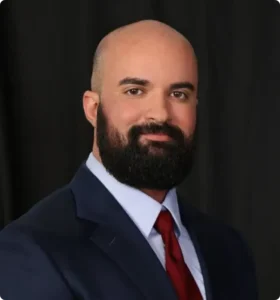
Zachary Gold, Esq. owns Cruz Gold & Associates and is the attorney you speak with at your first consultation. He has more than seven years of legal experience and started his career as a paralegal.
He is a Rutgers University alumnus, earned his law degree at Drexel University, and is a member of the American Immigration Lawyers Association. His mother, Marta Cruz Gold, founded the firm in 1995, and his interest in immigration law comes from his own parents' move to the United States. Read more about Zachary and the firm.
Questions from engaged couples
How much does a K-1 visa lawyer cost?
A flat fee for the petition and visa stage and a separate flat fee for the green card application after the wedding, both quoted at the free consultation. Government fees of $2,380 per adult come on top, and our page on immigration lawyer fees explains how we charge.
Do I need a lawyer for a K-1 visa?
The law does not require one, and many couples file the I-129F themselves. The costly mistakes are about dates: a divorce that was not final on the filing day, or a last visit more than two years before filing, and either one means a new petition and a new fee. An arrest on record, which must be disclosed even if sealed, an earlier visa refusal or overstay by your partner, or a passport from a country under travel restrictions are also reasons to have the case checked first.
Can you get a K-1 visa without meeting in person?
Only with a waiver. The law requires one meeting in person in the two years before filing, and USCIS waives it only for extreme hardship to the U.S. citizen or when meeting before the wedding would break strict customs of your partner's culture (8 CFR 214.2(k)(2)).
Can a K-1 visa holder work?
Yes, with a work permit, and the useful one comes after the wedding. The permit available on arrival ends on day 90, so most couples file for work authorization together with the green card application: it costs $260 and was decided within about 12 months in USCIS's October figures.
Does the travel ban affect K-1 visas?
Yes, for nationals of the 19 countries under a full suspension since January 1, 2026, unless an exception applies. For the 19 countries under partial restrictions, such as Cuba, Nigeria and Venezuela, K visas are not among the suspended categories.
Can a green card holder sponsor a fiancé(e)?
No: only U.S. citizens can file a K-1 petition (I-129F instructions). A green card holder can marry first and file a spouse petition, which waits in the F2A line explained on our marriage green card page, or become a citizen first and then file the K-1, the step our citizenship lawyer page covers.
Related pages
Take the First Step Towards Peace of Mind
We’re here to help you navigate your legal journey with confidence and care. Pick a time below for a free 20-minute consultation with attorney Zachary Gold.

Reach Out for Trusted Support

CONTACT US
Phone: (609) 924-8500
Email: [email protected]
830 Bear Tavern Rd Ste 108, Ewing Township, NJ 08628, United States
© 2026 All Rights Reserved | Cruz Gold & Associates | Privacy Policy